
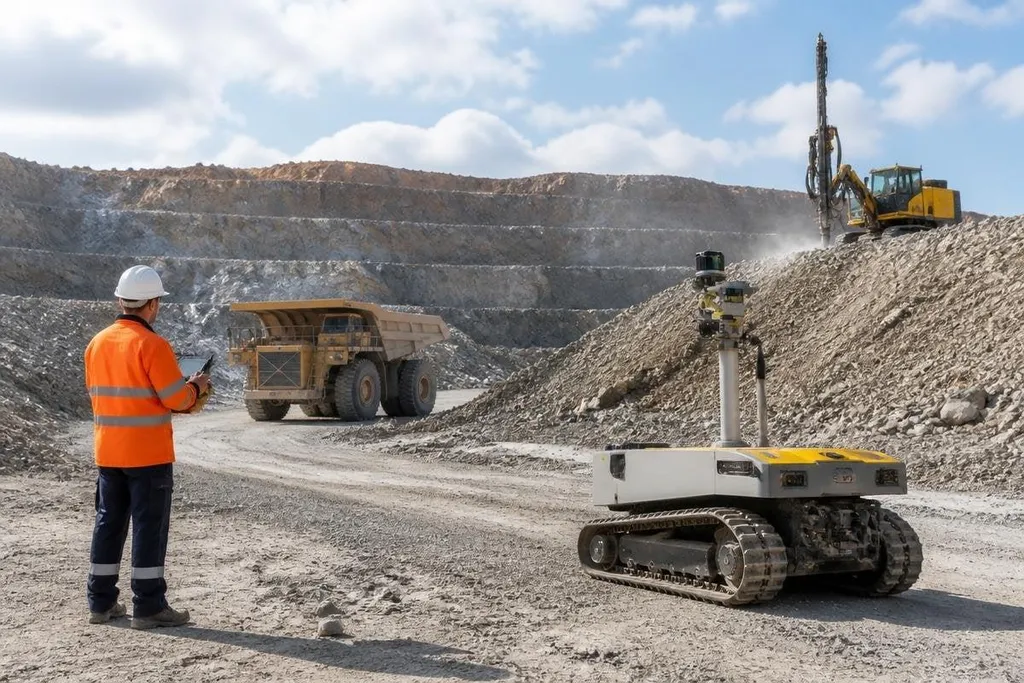
Mining robots are taking on work that puts people near falling rock, moving vehicles, dust, water, and unstable ground. The useful question is not whether a robot looks autonomous, but which task it can perform safely and repeatedly in a real mine.
- Robots can inspect areas before people enter.
- Remote machines can handle drilling, hauling, and mapping.
- Human oversight still matters when ground or weather conditions change.
Where mining robots work
Mining companies use automation in places where a machine can repeat a defined task. Underground robots may inspect tunnels, check equipment, or collect data from areas that are hard to reach. Surface mines can use autonomous haulage systems, drilling machines, and survey vehicles.
A mining robot usually combines cameras, LiDAR, radar, and other sensors. LiDAR measures distance with laser pulses, helping the system build a map of walls, roads, vehicles, and obstacles.
Software then compares fresh sensor data with the planned route. That process matters because a mine is not a clean factory floor. Rock can shift, roads can change, water can cover a path, and dust can block a camera. A robot that works in a test area may need a remote operator when its sensors disagree or the route changes.
What changes for mine workers
Remote operation moves people away from some dangerous zones. An operator can control a machine from a safer room while watching video, sensor readings, and equipment status. The work does not vanish; it shifts toward planning, supervision, maintenance, software support, and safety checks.
This change also affects how a mine plans its shifts. A machine can keep working in a zone after workers leave, but that only helps if charging, maintenance, network access, and recovery plans are ready. A disabled vehicle in a tunnel still needs a person or another machine to reach it.
The strongest use case is a task with clear boundaries and a repeatable route. Drilling along a planned pattern fits that model better than handling loose rock after an unexpected collapse. Robots work best when the mine gives them a known job and a clear way to stop.
Mining robots are judged by the work they finish and the conditions they face. Robot24 can add reports on named machines and field tests before the next section looks at the measurements they produce.
What robots can measure
These machines can gather information that is hard to collect by hand. A mapping vehicle can record tunnel shape, road condition, or stockpile size. An inspection robot can carry a thermal camera or gas sensor, depending on the task and the mine’s safety plan.
The value comes from repeated records. A mine can compare new scans with earlier ones and look for movement, heat, damage, or changes in a work area. The system still needs a person to decide what those changes mean and what action should follow.
Data links are a limit. Underground rock can block radio signals, and a robot may lose contact around corners or behind thick walls. Safe operation needs a stop response, a recovery method, and a plan for operation after the link returns.
What remains unproven
A demonstration can show a robot completing one route. It does not show how the machine handles a full shift, tire damage, dust on its sensors, a blocked road, or a software fault. Mining companies need site records before they can judge the real cost of automation.
The purchase price is only one part of that cost. Training, network changes, spare parts, software support, insurance, and worker retraining can shape the result. A mine also needs to check whether the robot fits its existing trucks, drills, control systems, and safety rules.
I'd wait for mine-specific operating records before treating a robot as ready for a broad rollout. The machine may work well on one task and still fail the wider production plan.
A practical buying checklist
Use these questions before choosing a mining robot:
- Name the task: Can the machine repeat one job with a clear start and stop point?
- Check the site: Do its sensors and network work through dust, water, darkness, and rock walls?
- Plan recovery: Who reaches the machine if it stops, and how do they remove it safely?
- Price the whole system: Include training, maintenance, software, spare parts, and network work.
- Set the human role: Decide who supervises the robot and who can stop it.
- Demand site records: Ask for operating results from a mine with similar ground and work.
The mining industry will change first in narrow jobs where distance, repeatability, and worker safety matter. The next useful proof is not a polished demo; it is a mine record showing how many hours the robot worked, how often people took control, and what it cost to keep running.